Are you chatty, friendly, quiet or funny? Do you have a talent for football or maybe art or singing? Whatever you’re like, were you born like this or are there are other factors to consider?
“It’s not as if there is one particular gene for intelligence or a single gene for being friendly, it’s much more complicated than that,” explains Dr Jonathan Pugh (pictured left).
He says that there are certainly aspects of our character which have a significant genetic basis (i.e. things that we are born with). But exactly what aspects, and to what extent genetic factors determine them, is actively being researched. This research hopes to give us a better understanding of how we turn out the way we do.
Genes and environment
It's sometimes suggested that our genes are the only thing that influences our characteristics – an idea called genetic determinism. Dr Pugh thinks this is perhaps a bit too simple.
“The closest to the truth that genetic determinism gets is when you talk about diseases which are based on a single gene going wrong, and of course some of those diseases can be very serious and have quite a devastating effect.” He explains that: “…in these cases, if you’re suffering from a serious single-gene disease, this is likely to have huge implications for your life and the way in which you live.”
However, he is clear that it isn’t just our genes that make us the people we are – our environment and what goes on around us also have an impact.
“Even if we do have the right sort of genetic combination associated with a particular characteristic, environmental influences will also determine the way in which we develop that characteristic,” he says. For example, we may have a certain set of genes that makes us more likely to become aggressive. However, we may only find this out and act upon this if we have particular triggers in our environment. This could include confrontational situations with family and friends, an inability to get a good night's sleep at home and so forth.
“So I don’t think that there is a simple genetic basis for personality. Our genes certainly matter, but they’re not the only thing that matters,” explains Dr Pugh.
Dr Pugh also points out that further examples to illustrate some of the philosophical ideas about identity exist in books and on television.
“Ebenezer Scrooge is a very interesting character,” he says, referring to the main character in Charles Dickens’ festive novel ‘A Christmas Carol’. Scrooge is famously visited by three ghosts and decides to change his money-hoarding ways, start embracing Christmas and be a more open, loving person. “He’s someone who does undergo a quite radical change but we still feel that he is ultimately the same person.”
Changes
Dr Pugh has a particular interest in questions of identity, and how medicine and surgery can change people’s behaviour. He talks about an example from history whereby an American man named Phineas Gage (1823-1860) suffered a brain injury while working on a railroad in which a metal pole blasted through his head. Though Gage (pictured below) amazingly survived the damage to his skull and brain, records suggest that over the next few months he underwent a major personality change.
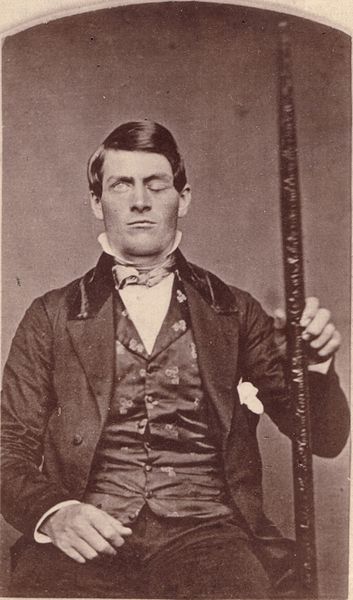
“He used to be a well-liked and respected person. But after the accident he turned into a gambler and developed some unpleasant character traits, so much so that his friends went round saying this is no longer Gage: it’s an imposter,” says Dr Pugh. “It’s almost as radical a change as Scrooge undergoes but it seems plausible to say Gage has changed as a person, whereas Scrooge didn’t”. Read more about Gage’s case.
“Perhaps one reason for that is when Scrooge undergoes this radical change it’s something that he knows about and understands i.e. he changes because he’s haunted by the three different ghosts who make him think about the way he behaves. Namely, it becomes clear that continuing as he is may result in him dying alone which frightens Scrooge".
“In contrast, with Gage, there wasn’t really anything to get a handle on. There wasn’t a way in which these characteristics were a response to his own understanding of the value of different character traits. We now know that the area of the brain that this rod went through was the frontal lobes, which is the biological seat of personality.”
Dr Pugh says that the ways our brains work do change as we go through life and react to and learn from things that happen to us. However, this is typically a response to the way that we interact with the world, rather than a biological change being imposed upon us.
He refers back to one of the most important philosophers who put together ideas about identity, John Locke (1632-1704). Locke argued that identity is not really to do with the body, but about your mind (or consciousness), especially your memory.
“Imagine you’ve got a prince and a cobbler, and you switch round their consciousnesses. The prince’s consciousness is in the cobbler and the cobbler’s consciousness is in the prince,” says Dr Pugh. “Even though you have the same bodies in front of you, you’d tend to think the identity goes with the consciousness. You’d talk about the prince being in the cobbler’s body and the cobbler being in the prince’s body – you’re unlikely to think that they’re still the same person.”
What do you reckon? Take a look at the video below which discusses Locke's theory in terms of forensics and determining criminal responsibility:
https://www.youtube.com/watch?v=e1iy8fMCe0o
Nowadays, as people live longer, they also experience memory loss, sometimes severely, with conditions such as Alzheimer’s disease. Dr Pugh suggests that by using Locke’s approach, you could potentially argue that once someone loses a significant amount of memory, they’re not really the same person anymore. But this is a controversial idea and it’s key to remember that Locke’s theory was developed in the 17th century without the expectation and knowledge that medical advances might allow people to live so long.
“After all, the person you’re talking about is still in the same body and still looks the same, and may have several of their original characteristics. In some ways the development of medicine is starting to put more pressure on this quite old philosophical idea,” he says.
A life online
One interesting thing that Dr Pugh thinks might become more important when we think about memory and identity is the role of social media. When you upload a photo to Instagram, or post a status to Facebook, or write a tweet that goes viral, you are creating a bank of memories for yourself in the years to come.
“It’s going to be very interesting in the future to see how we change our thinking about identity over time when a lot of things that are important to our identity now are starting to have this online presence and a life of their own,” he says. What do you think Locke would say about this?
And so thinking about your own identity, what do you believe has made you the person you are today? Where you live? Where you’ve travelled? The people around you? Or do you think you were born the way you are and you’ve not changed? It’s a fascinating debate and one that will continue as scientific evidence and new technology develops.
How did the idea come about?
The soul is broadly defined as the spiritual and emotional essence of a person which can include their mind, character and thoughts (source). But this is a hotly debated topic and in particular, the relationship between the soul and the body has greatly divided opinion.
Dr Moyse (pictured left) explains that, according to Western tradition, the idea of the soul is first thought to have originated from the writings of Ancient Greek philosophers, including Plato (~429–347 B.C.E.) and Aristotle (384-322 B.C.E.). Plato is believed to have held what’s known as a ‘dualist account’ of the soul. This is where the soul is considered separate to the body and the body acts as a prison for the soul...a bit like the shell that surrounds an oyster.
Eastern religions take on a similar type of thinking. For example, the concept of reincarnation in Hinduism, Buddhism and Sikhism all speak about the soul moving from one being/animal to the next. According to this line of thought, the soul is a source of unending life and not something that can be physically seen or objectified.
Is there another way of looking at it?
Yes, several. The ‘holistic approach’ sees the soul as united with the body in an unbreakable bond. You can see this sort of thinking in Aristotle’s De Anima where he argues that the body and soul are the animal and so the soul cannot be separated from the body. Likewise, an influential theologian of the early Christian church, St Basil (~330–379 C.E) wrote: ‘as the flesh was moulded, the soul was made’. Far from being imprisoned, the soul is a gift in the active creation of the body.
For Gregory of Nyssa (~335–395 C.E.), the brother to St Basil, the soul and body are a commixture or community, which is preserved even after death. Although this is characteristic of early Christian thinking, it’s also a stance which continues to be taken by multiple strands of Christianity today (the Roman Catholic, Protestant and Orthodox Churches).
Plato offers further thoughts, linking the soul to a person’s moral judgement. In his 7th letter, he wrote that the part of us that grasps hold of the truth and distinguishes between good and bad is meaningless without a soul. In his Nichomachean Ethics, Aristotle seems to agree. The moral significance of the soul is nurtured by habits, or practices, of character formation. These habits make us who we are, shaping our being.
You can read similar thoughts in the early Christian writings of Augustine (354 – 430 C.E.) and the medieval scholastic writings of Thomas Aquinas (1225 – 1274 C.E.), who suggest that while the soul may be the better part of humanity, the union of the body and soul are essential when speaking about being a human.
What are the more modern(ish) debates?
Dualist accounts have continued across history. René Descartes’ (1569 – 1650 C.E.), for example, argued that our soul is known to us simply because it thinks—and it is immortal—while the body is as an earth-made statue or machine. For Descartes, the body and mind are distinct but your soul and mind are the same thing. In his view, it is your mind (the part of you which is capable of judgement and rational thought) and not your body that makes you who you are.
In the advent of new and digital technologies, the mind-body debate has featured in discussion over theories of transhumanism. This is where philosophers, scientists, and others, have been exploring the idea of transferring a person’s personality and ways of thinking (their mind) on to a computer chip (or other digital technology). In this approach, the mind is seen as most important and by preserving this via digital technology, a person can live on without biological limits. What do you think – could we all live forever through modern technology like this?
How does this link to identity?
Dr Moyse explains that if our identity is about who we are in the world, then the soul has a role to play but there are many tricky questions to think about. For example, if we were to think of the body as unimportant, does it mean that we can remake it in whatever image we desire and take on other identities? This would make sense to some. But to others who see the soul and body as intricately linked, it might seem like we are damaging an essential part of who we are. In his research, Dr Moyse explores questions like these. He is particularly interested in how certain ways of thinking have shaped the way medical professionals have come to see and to control the bodies of patients, while leaving spiritual care practitioners to give care to persons’ souls. He is further concerned with the ways patients have learned to speak about themselves, and their bodies and souls.
This is certainly a though-provoking subject…which definition of the soul makes most sense to you?
Writer, Virginia Woolf once said: 'I am made and remade continually. Different people draw different words from me'. What do you think she meant by this?